
In Memoriam: Kenneth W. Ford (1926–2025)
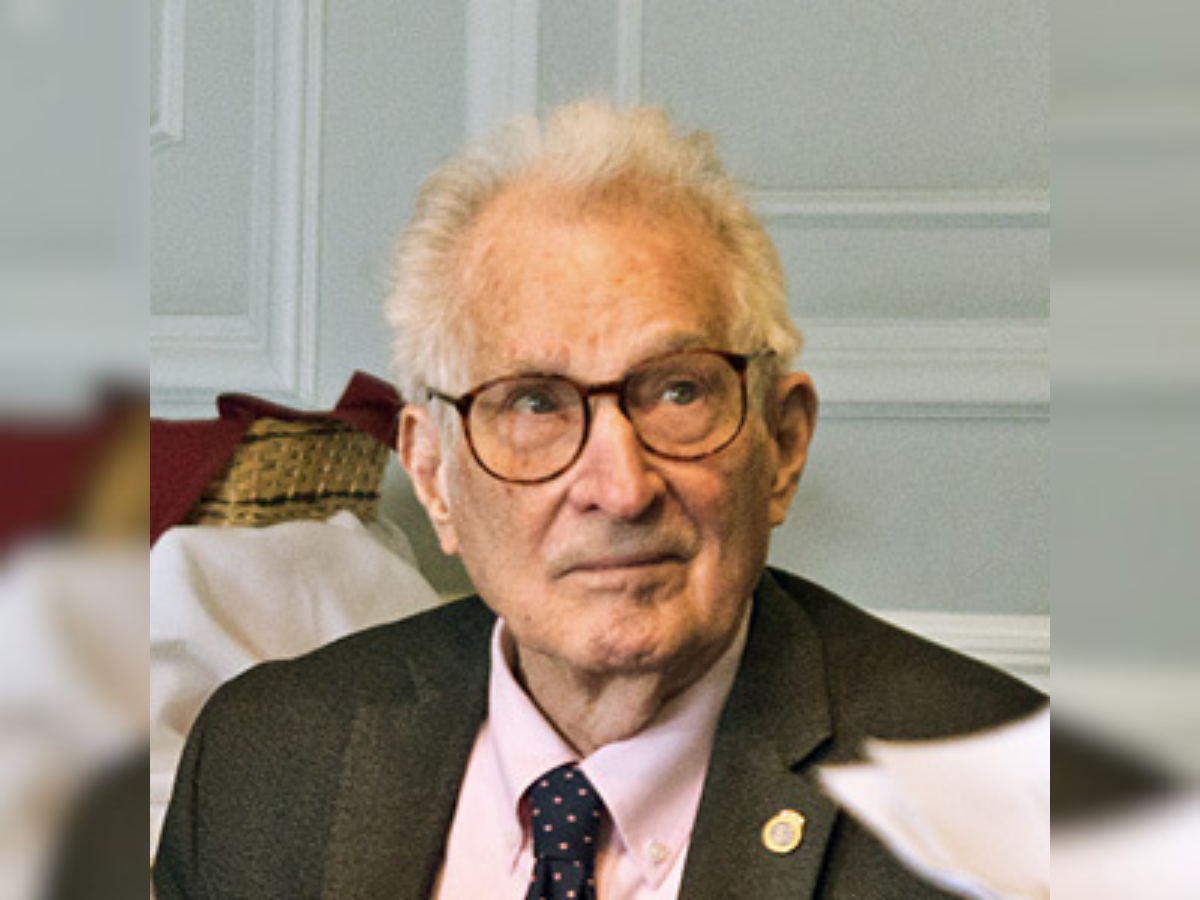
Ford leaves an enduring legacy as a scientist, educator and institution builder. His vision helped shape UC Irvine’s early trajectory in the physical sciences. The School of Physical Sciences honors his foundational role in our history and celebrates the broad impact of his distinguished life.
The UC Irvine School of Physical Sciences mourns the passing of Kenneth W. Ford, the founding chair of UC Irvine’s Department of Physics and a distinguished theoretical physicist, educator, executive, and award‑winning writer. Dr. Ford died Dec. 5, 2025, at the age of 99.
Ford leaves an enduring legacy as a scientist, educator and institution builder. His vision helped shape UC Irvine’s early trajectory in the physical sciences. The School of Physical Sciences honors his foundational role in our history and celebrates the broad impact of his distinguished life.
A scientist of remarkable breadth, Ford contributed to nuclear theory, science education and national scientific leadership over a career spanning more than seven decades. He was likely one of the last surviving members of Project Matterhorn, the classified Princeton group that carried out early theoretical work leading to the development of the hydrogen bomb in the early 1950s.
Ford was recruited in 1964 to become the first chair of the UC Irvine Department of Physics, playing a formative role in building the new campus’s scientific community. Among his most consequential achievements was his successful recruitment of Fredrick Reines, who would later receive the Nobel Prize in Physics for the detection of the neutrino. Ford’s early leadership helped establish UC Irvine as a home for ambitious and creative physics research.
Ford made influential contributions through the application of the nuclear shell model and the collective model and conducted extensive studies of muonic atoms. His highly cited paper “Semiclassical Description of Scattering,” co‑authored with John A. Wheeler, remains a foundational contribution in the field. His first publication, co-authored with David Bohm in 1950, provided early evidence for nuclear transparency to neutrons, and his later works continued to clarify nuclear structure through both theoretical insight and the analysis of emerging experimental data.
Beyond academia, Ford held significant leadership roles in scientific institutions. He served as President of the New Mexico Institute of Mining and Technology from 1975 to 1982, guiding substantial growth and overseeing the construction of the Macey Center. As chief executive officer of the American Institute of Physics from 1987 to 1993, Ford conducted successful negotiations to retain the Russian translation program during a time of upheaval in the Soviet Union. He also shepherded the relocation of the organization’s headquarters from New York City to College Park, Maryland.
Ford authored 11 books across technical, historical and popular science genres. His The World of Elementary Particles (1963) received a science writing prize in Italy, and Geons, Black Holes, and Quantum Foam: A Life in Physics (1998), co‑authored with John Archibald Wheeler, won the 1999 American Institute of Physics Science Writing Prize. His textbooks, including Basic Physics (1968) and the three‑volume Classical and Modern Physics (1972–74), educated generations of students.
In the later part of his life, Ford published accessible works such as The Quantum World: Quantum Physics for Everyone (2004) and 101 Quantum Questions (2011), continuing his commitment to public understanding of science.
Ford’s exceptional contributions to physics education were recognized with the Oersted Medal from the American Association of Physics Teachers in 2006, the organization’s highest honor, along with an earlier Distinguished Service Citation in 1976.
From 1970 to 1975, Ford worked as a professor at the University of Massachusetts in Boston. He then served as President of New Mexico Tech until 1982, and then as Executive Vice President of the University of Maryland until 1983. Ford later returned to the classroom to teach high‑school physics at Germantown Academy and Germantown Friends School from 1995 to 1998.
As an avid pilot for more than 50 years, Ford earned the Diamond Badge for his gliding accomplishments. He also enjoyed folk dancing, playing the recorder, Scrabble, Wordle and time with family.
Ford is survived by his seven children: Paul, Sarah, Nina, Caroline, Adam, Jason, and Star; along with 13 grandchildren and one great‑grandson.